
A well-defined FinOps strategy gives companies a clear edge in managing and optimizing cloud costs, and several studies support this.
For instance, a 2023 Deloitte article states that FinOps can help businesses reduce cloud costs by nearly 40%.
However, as cloud environments continue to grow more complex, many businesses are realizing that relying solely on FinOps is no longer enough.
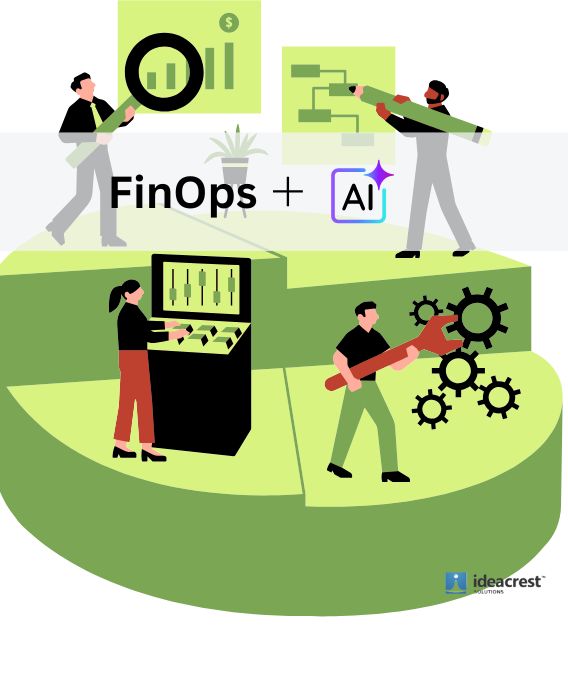
As a result, they are experimenting with AI in their FinOps models, and the results are promising.
To give you an idea of the impact, a 2023 study by Tangoe shows that combining AI with FinOps can lead to an additional 20% savings on cloud costs, which brings us to the key question:
How AI in FinOps Helps You Minimize Costs
To answer this, we first need to examine the main reason behind the growing complexity of cloud environments.
It stems from the rapid expansion of cloud providers' service offerings, each tailored to address specific business needs.
This explosion of options creates infrastructure visibility issues and complicated pricing structures based on location, usage, and models, which makes it harder for FinOps teams to manage costs effectively.
This is where AI steps in, offering intelligent automation and real-time insights to strengthen the FinOps model.
Now, let’s explore how AI enhances FinOps in practice.
1. Fixing Resource Waste
Companies often overspend on unused or underutilized cloud resources, which is a major cost concern.
AI helps address this issue by continuously monitoring cloud infrastructure, detecting usage patterns, and providing real-time optimization recommendations.
2. Spotting Unusual Cloud Costs
AI models can continuously monitor overspending on cloud usage by easily detecting spending anomalies.
3. Cost Prediction
AI can forecast cloud costs using historical and market data, enabling smarter budgeting and resource planning.
Together, these capabilities transform FinOps from a reactive cost-control model into a proactive strategy for ongoing cloud cost optimization.
And if you want a clearer picture of the impact AI in FinOps can have on your business, then let’s take a look at this example.
Scenario: Cloud Cost Spike from Over-Provisioned Compute Resources
A tech company runs microservices on Kubernetes across AWS. Over the past quarter, cloud costs have ballooned, primarily due to over-provisioned compute instances and idle resources.
The goal is to reduce spending without impacting performance or reliability.
Approach 1: FinOps
| Steps | Action | Outcome |
|---|---|---|
| 1 | Use AWS Cost Explorer to identify top spend categories | Finds EC2 and EKS clusters are consuming most of the budget |
| 2 | Manually review resource utilization metrics | Discovers several pods are over-provisioned and underutilized |
| 3 | Set static budget alerts | Alerts trigger after thresholds are breached |
| 4 | Right-size instances based on historical averages | Saves ~10–15% by downgrading instance types |
| 5 | Schedule periodic manual audits | Helps catch unused volumes and zombie services quarterly |
Results
- Total Savings: ~15–20%
- Time to Implement: 3–4 weeks
- Limitations: Reactive, labor-intensive, and slow to adapt to dynamic workloads
Approach 2: FinOps + AI
| Steps | Action | Outcome |
|---|---|---|
| 1 | Deploy AI agent to auto-tag resources by service and team | Instantly maps cost to owners and workloads |
| 2 | AI anomaly detection flags idle and over-provisioned nodes in real time | Prevents weeks of waste before manual audits would catch it |
| 3 | Predictive ML model forecasts future usage patterns | Enables proactive scaling and budget planning |
| 4 | AI recommends optimal instance types and autoscaling policies | Saves 30–40% by dynamically adjusting resources |
| 5 | AI automates cleanup of unused volumes and orphaned services | Continuous hygiene without human intervention |
Results
- Total Savings: ~40–50%
- Time to Implement: 1–2 weeks with AI tools
- Advantages: Proactive, scalable, and adaptive to changing workloads
Conclusion
While FinOps practices help you save significantly on cloud costs, integrating AI takes it a step further.
AI not only enhances the benefits of FinOps but also equips your business for future scalability and smarter budget management.
So, try incorporating AI tools into your FinOps model and experiment with your cloud projects to see the impact for yourself.
And if you need expert advice on the topic, then drop us a line at info@ideacrestsolutions.com.